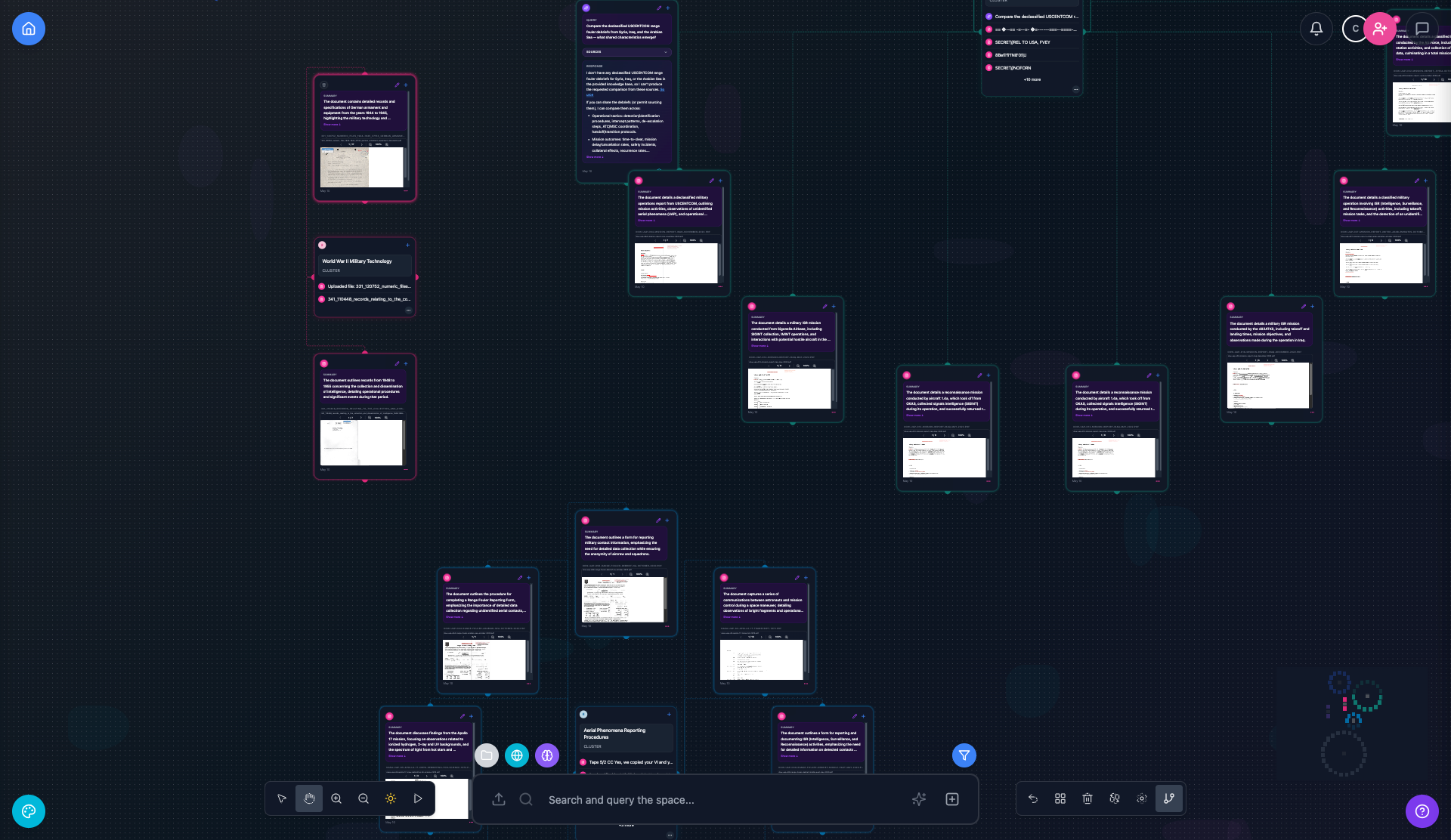
Intelligence products are created in isolation across units, classification levels, and time periods. Analysts working on related threat streams often produce redundant or incomplete assessments because no system maps the relationships between their work. The connections surface during briefings — or they don't.
An analyst in one unit produces an assessment on a threat network. Two weeks earlier, another unit completed a related product covering overlapping entities. Neither analyst sees the other's work. Across large organizations, this isn't an edge case — it's the default. Redundant analysis wastes hundreds of analyst hours per year, and worse, critical connections between threat streams go undetected.
Classification boundaries compound the problem. The most important context often lives on the other side of a classification boundary. Analysts carry insights between systems manually, losing fidelity and attribution at every handoff. The result is assessments built on incomplete foundations that nobody can trace end-to-end.
And when a senior analyst rotates or retires, the operational understanding they built over a decade — which entities are connected, which sources are reliable, which historical patterns matter — leaves with them. Onboarding their replacement takes months. Some of that knowledge is never recovered.